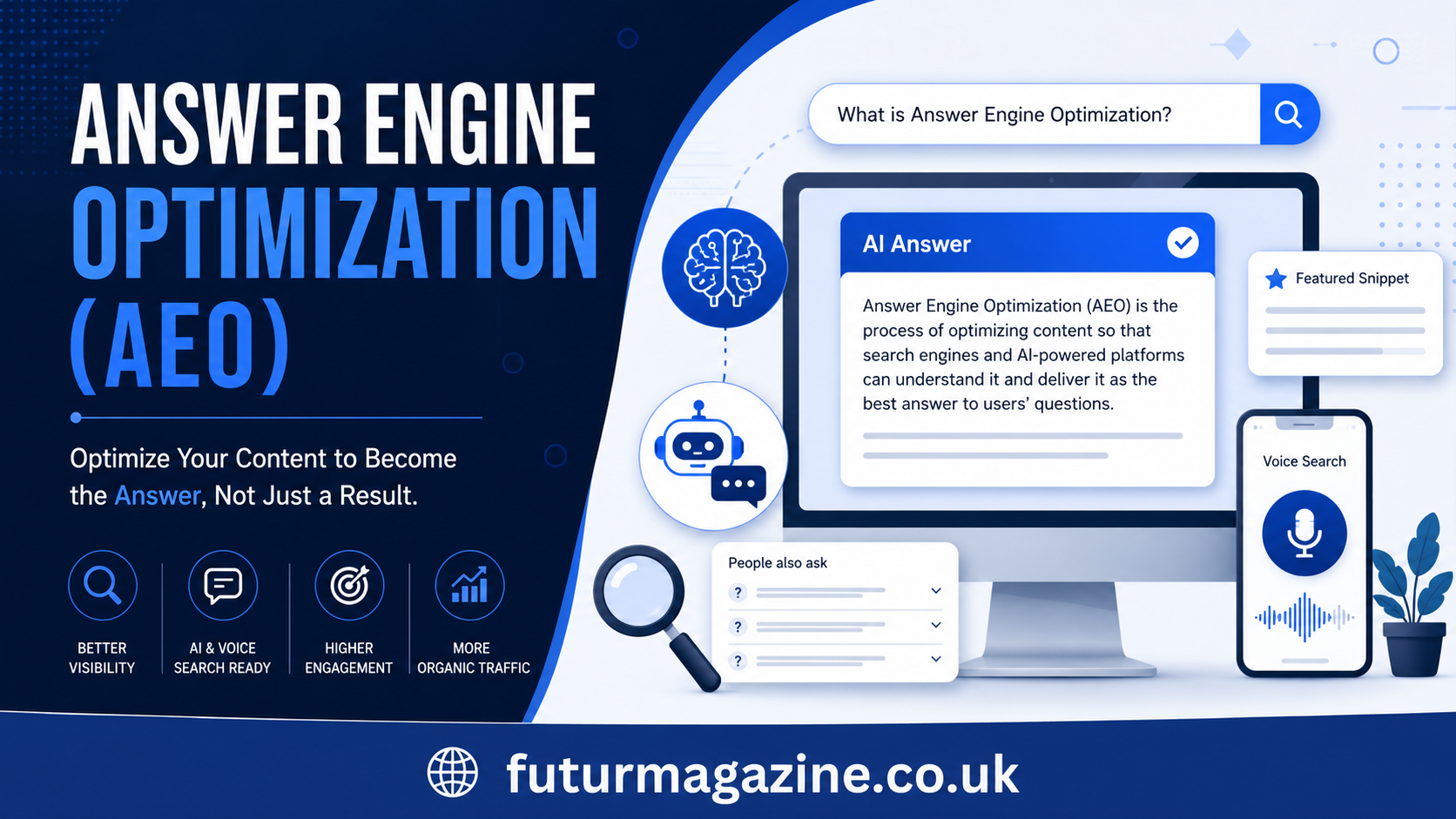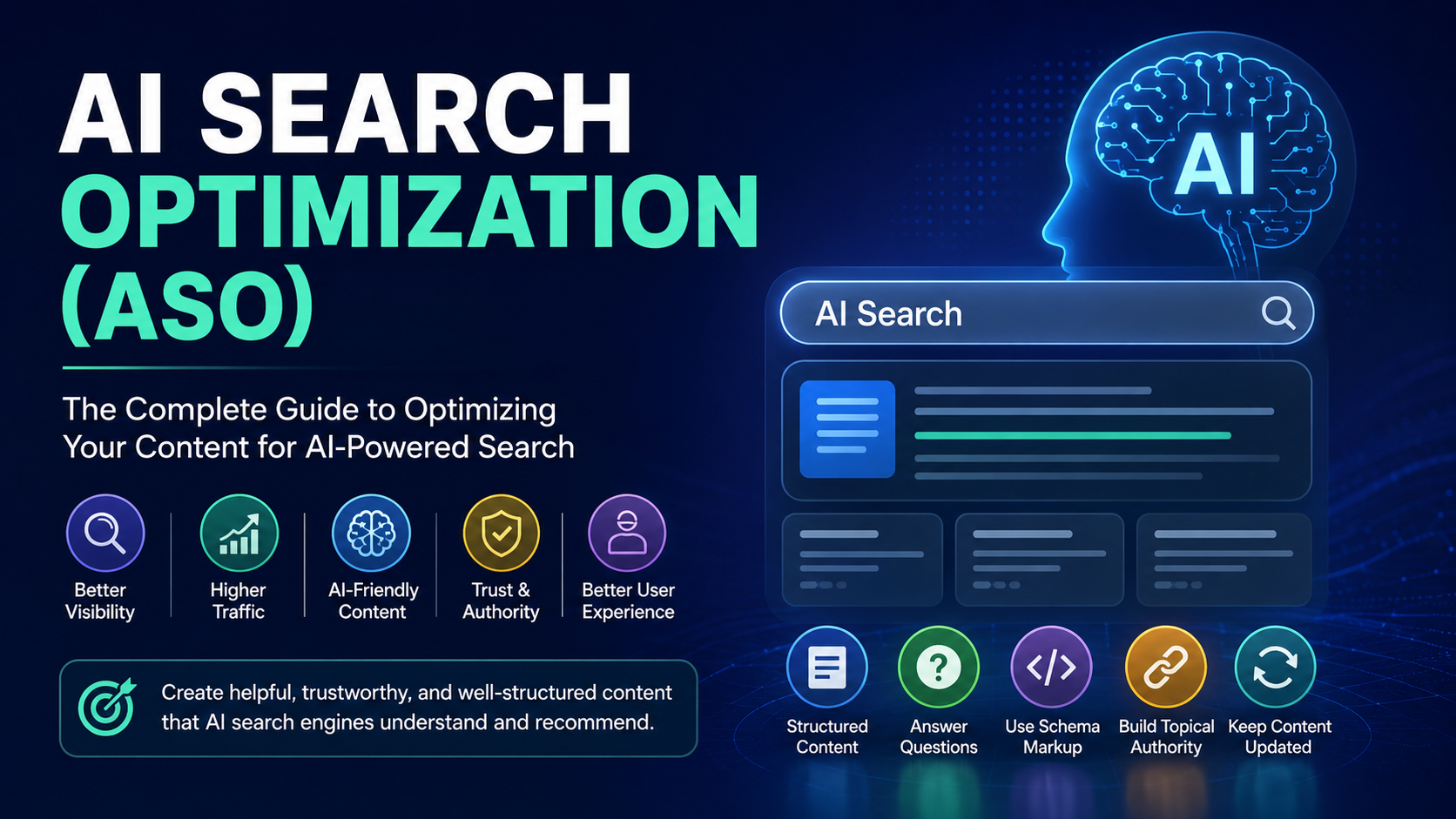
Artificial Intelligence is changing how people search for information online. Instead of clicking through several websites, many users now ask AI assistants direct questions and receive complete answers within seconds. This shift is changing SEO in a big way.
That is where AI Search Optimization (ASO) comes in.
AI Search Optimization helps your content become useful not only for traditional search engines like Google but also for AI-powered tools such as ChatGPT, Google AI Overviews, Microsoft Copilot, Perplexity AI, and other conversational search platforms.
If your content is well-structured, trustworthy, and easy to understand, AI systems are more likely to use it when generating answers.
In this guide, you’ll learn what AI Search Optimization (ASO) is, why it matters, how it differs from traditional SEO, and the practical steps you can take to prepare your website for the future of search.
Table of Contents
- What Is AI Search Optimization (ASO)?
- Why AI Search Optimization Matters
- How AI Search Works
- AI Search Optimization vs Traditional SEO
- Core Principles of AI Search Optimization
- Create Helpful Content First
- Write for Humans Before Search Engines
- Structure Content for AI Understanding
- Optimize for User Intent
- Use Clear Questions and Answers
What Is AI Search Optimization (ASO)?
AI Search Optimization (ASO) is the process of creating and organizing website content so AI-powered search systems can easily understand, trust, and use it when answering user questions.
Unlike traditional SEO, which mainly focuses on improving rankings in search engine results pages (SERPs), ASO focuses on making your content useful for AI-generated responses.
An AI system looks beyond keywords. It tries to understand:
- The meaning of your content
- Whether your information is accurate
- If your website appears trustworthy
- How clearly your ideas are explained
- Whether your content directly answers user questions
Think of ASO as optimizing your website for both humans and intelligent machines.
Why AI Search Optimization Matters
Search behavior is changing rapidly.
More people now ask complete questions like:
- What is AI Search Optimization?
- How does ASO improve SEO?
- What is the difference between SEO and ASO?
- How do I optimize my website for AI search?
Instead of showing only a list of links, AI tools often generate one detailed answer.
If your content is well-written and authoritative, it has a better chance of being included in these AI-generated responses.
Benefits of ASO include:
- Better online visibility
- Increased brand authority
- More organic traffic opportunities
- Higher trust from users
- Future-proof content strategy
- Better user experience
Businesses that adapt early may gain an advantage as AI search becomes more common.
How AI Search Works
Understanding AI search makes optimization much easier.
Most AI search systems follow a process similar to this:
- Understand the user’s question.
- Identify the search intent.
- Retrieve reliable information.
- Compare multiple trusted sources.
- Generate a clear answer.
- Sometimes provide links to original sources.
Unlike older search engines, AI focuses more on meaning than exact keyword matches.
For example:
User Query
How can I optimize my website for AI search?
Instead of simply finding pages with those exact words, AI searches for content discussing:
- structured content
- helpful information
- E-E-A-T
- semantic SEO
- user intent
- content organization
This is why writing naturally is becoming more important than repeating keywords.
AI Search Optimization vs Traditional SEO
Although they work together, SEO and ASO have different goals.
| Feature | Traditional SEO | AI Search Optimization |
| Main Goal | Rank higher in search results | Become a trusted source for AI answers |
| Focus | Keywords and rankings | Context and understanding |
| Content Style | Search optimized | Human-first and AI-friendly |
| User Intent | Important | Extremely important |
| Authority | Helpful | Essential |
| Structured Content | Useful | Very important |
| Readability | Important | Critical |
The best websites today combine both SEO and ASO rather than choosing one over the other.
Core Principles of AI Search Optimization
Successful ASO follows several important principles.
1. Prioritize Helpful Content
Every page should solve a real problem.
Ask yourself:
- Does this answer the user’s question?
- Is the information complete?
- Would someone bookmark or share this page?
Helpful content performs better for both search engines and AI systems.
2. Build Trust
AI models prefer content that appears reliable.
Trust signals include:
- Clear author information
- Accurate facts
- Updated content
- References to reliable sources
- Transparent writing
Avoid exaggerated claims or unsupported statements.
3. Focus on Context
Instead of repeating one keyword many times, explain related ideas.
For this topic, related concepts include:
- AI search
- semantic search
- conversational search
- natural language processing
- search intent
- content optimization
- entity SEO
- structured data
- user experience
Using related terms naturally helps AI understand your content.
4. Improve Readability
Short paragraphs make content easier to understand.
Good formatting includes:
- headings
- bullet lists
- numbered steps
- comparison tables
- simple language
- logical flow
Well-organized content is easier for both readers and AI systems.
Create Helpful Content First
Many people still write content only to rank higher on Google.
That approach is becoming less effective.
Instead, start by asking:
“What problem does my reader need to solve?”
For example, someone searching for AI Search Optimization (ASO) probably wants to know:
- what it means
- why it matters
- how to implement it
- whether it replaces SEO
- practical optimization tips
If your article answers all these questions clearly, both readers and AI systems will find it valuable.
Write for Humans Before Search Engines
One of the biggest mistakes is writing content that sounds robotic.
Instead of this:
AI Search Optimization is important because AI Search Optimization improves AI Search Optimization rankings.
Write naturally:
AI Search Optimization helps search engines and AI assistants better understand your content. Clear writing and helpful information improve your chances of being recommended in AI-generated answers.
Natural writing improves readability and keeps visitors engaged longer.
Structure Content for AI Understanding
AI systems process content more effectively when it follows a logical structure.
Use:
Clear headings
Each section should cover one main idea.
Short paragraphs
Limit paragraphs to two to four sentences.
Lists
Lists make information easier to scan.
Example:
Benefits of structured content:
- Easier reading
- Better organization
- Faster understanding
- Higher engagement
- Improved AI interpretation
Tables
Comparison tables help explain differences quickly.
Optimize for User Intent
Not every visitor wants the same answer.
Some users are learning.
Others want practical advice.
Some are comparing tools.
Understanding intent helps create more useful content.
For example:
| Search Query | User Intent |
| What is AI Search Optimization? | Learn |
| ASO vs SEO | Compare |
| How to optimize for AI search | Practical steps |
| Best ASO tools | Research |
Your content should satisfy these different needs wherever possible.
Use Clear Questions and Answers
AI models often pull answers from content that directly responds to common questions.
Instead of writing long introductions before answering, provide concise explanations first.
Example:
What is AI Search Optimization?
AI Search Optimization is the practice of creating trustworthy, well-structured, and user-focused content that AI-powered search systems can easily understand and use when answering questions.
After giving the direct answer, expand with examples and additional details.
This approach improves readability and increases the chances of appearing in featured snippets and AI-generated responses.
Continue: Practical AI Search Optimization Strategies
Now that you understand the basics of AI Search Optimization (ASO), it’s time to learn how to apply these principles to your website.
Create Topical Authority
AI systems prefer websites that cover a topic in depth instead of publishing random, unrelated articles.
For example, if your website focuses on digital marketing, create content around related topics such as:
- SEO fundamentals
- Technical SEO
- Keyword research
- Content marketing
- AI Search Optimization
- Local SEO
- Link building
- Google Search Console
- Website performance
When multiple high-quality articles connect naturally, your website becomes a stronger authority on the subject.
Tips to Build Topical Authority
- Publish content consistently.
- Cover beginner, intermediate, and advanced topics.
- Link related articles together.
- Update older content regularly.
- Avoid publishing thin or duplicate content.
Improve Content Structure
Well-organized content is easier for both readers and AI systems to understand.
A good article should include:
- A clear introduction
- Logical H2 and H3 headings
- Short paragraphs
- Bullet points
- Numbered steps
- Tables where useful
- A conclusion
- FAQs
Avoid writing large blocks of text. Clean formatting improves readability and user experience.
Demonstrate Experience and Expertise
Google’s E-E-A-T principles—Experience, Expertise, Authoritativeness, and Trustworthiness—also help make your content more valuable for AI search.
You can strengthen these signals by:
- Sharing practical examples.
- Explaining real-world use cases.
- Updating outdated information.
- Writing within your area of knowledge.
- Being transparent about limitations when appropriate.
People and AI systems are more likely to trust content that is accurate, practical, and clearly written.
Use Natural Language
Modern AI understands context, so you do not need to repeat the same keyword excessively.
Instead of forcing the phrase AI Search Optimization (ASO) into every paragraph, naturally include related terms such as:
- AI search
- AI-powered search
- conversational search
- semantic SEO
- search intent
- content optimization
- natural language
- structured content
- user experience
This creates content that reads naturally while remaining relevant.
Answer Questions Clearly
Many users search using full questions.
Include sections that answer these directly, for example:
How do I optimize content for AI search?
To optimize content for AI search:
- Understand user intent.
- Write helpful and accurate content.
- Use clear headings.
- Organize information logically.
- Build topical authority.
- Improve readability.
- Update content regularly.
- Add trustworthy sources where appropriate.
Clear answers also improve your chances of appearing in featured snippets.
Use Structured Data
Structured data helps search engines better understand your pages.
Common schema types include:
- Article
- FAQ
- Organization
- Breadcrumb
- Person
- HowTo (when appropriate)
While structured data does not guarantee rankings, it can improve how search engines interpret your content.
Keep Content Updated
AI systems and search engines generally favor content that stays current.
Review important articles every few months and:
- Fix outdated information.
- Add new examples.
- Improve readability.
- Answer new user questions.
- Remove broken links.
Fresh, well-maintained content often provides a better experience for readers.
Common AI Search Optimization Mistakes
Avoid these mistakes:
- Writing only for search engines.
- Publishing low-quality or duplicate content.
- Ignoring user intent.
- Overusing keywords.
- Using misleading titles.
- Publishing without proofreading.
- Neglecting internal linking.
- Allowing content to become outdated.
Focusing on quality is far more effective than trying to manipulate rankings.
Pros and Cons of AI Search Optimization
| Pros | Cons |
| Improves content quality | Requires ongoing updates |
| Supports long-term SEO | Takes time to build authority |
| Enhances user experience | Results are not immediate |
| Increases trust and credibility | Needs consistent content planning |
| Helps prepare for future search trends | Requires continuous learning |
Best Practices for AI Search Optimization
Follow these best practices:
- Write for people first.
- Answer search intent completely.
- Use clear headings and logical structure.
- Publish original, in-depth content.
- Keep articles updated.
- Build topical authority.
- Use internal links to related pages.
- Improve page speed and mobile usability.
- Avoid exaggerated or unsupported claims.
- Focus on trust, accuracy, and readability.
Key Takeaways
- AI Search Optimization (ASO) helps content become easier for AI-powered search systems to understand.
- ASO complements traditional SEO rather than replacing it.
- Helpful, accurate, and well-structured content performs best.
- Understanding user intent is essential.
- Natural language and semantic relevance matter more than keyword repetition.
- Building topical authority strengthens long-term visibility.
- Regular updates help keep content useful and trustworthy.
Frequently Asked Questions (FAQs)
1. What is AI Search Optimization (ASO)?
AI Search Optimization (ASO) is the process of creating high-quality, trustworthy, and well-structured content that AI-powered search systems can easily understand and use when answering user questions.
2. Is AI Search Optimization different from SEO?
Yes. Traditional SEO focuses on improving rankings in search engine results, while ASO focuses on making content suitable for AI-generated answers. Both strategies work best when used together.
3. Does AI Search Optimization replace SEO?
No. ASO complements SEO. Strong websites should optimize for both traditional search engines and AI-powered search experiences.
4. Why is user intent important for ASO?
AI systems aim to provide the most relevant answer to a user’s question. Content that directly satisfies user intent is more likely to be considered useful.
5. How often should I update my content?
Review important articles every few months or whenever significant changes occur in your topic. Regular updates help maintain accuracy and usefulness.
6. What type of content performs best in AI search?
Content that is original, well-organized, easy to read, accurate, and written to genuinely help users tends to perform best.
Conclusion
AI Search Optimization (ASO) represents the next step in the evolution of online search. As AI-powered search experiences become more common, websites that focus on helpful, trustworthy, and user-first content will be better positioned for long-term success.
The strongest strategy is not to chase algorithms but to create content that genuinely answers questions, demonstrates expertise, and provides value. By combining ASO with traditional SEO best practices, you can build content that serves both human readers and AI-powered search systems effectively.
Start by improving one article at a time. Organize it clearly, answer real questions, keep it updated, and focus on delivering accurate information. These habits will help your content remain valuable as search technology continues to evolve.